Your Collections Team Slept? How to Reduce NPAs
March 27, 2026
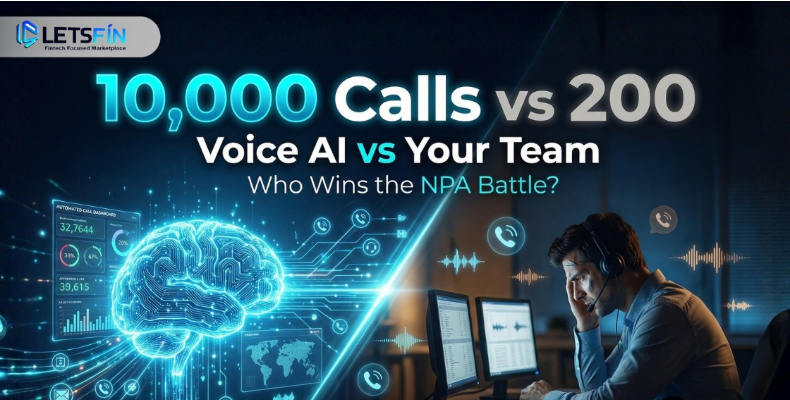
Your collections team clocked out hours ago. Follow-up calls scheduled for tomorrow are already 48 hours overdue. Three borrowers who were on the edge last week have not been contacted since Friday. One of them just missed their second consecutive EMI.
Across town, a competing NBFC's Voice AI just completed its 10,000th outbound collection call of the day. It did not take a lunch break. It did not miss a follow-up. It did not forget which borrower needed a softer tone and which one needed a firmer reminder. It logged every conversation, flagged every at-risk account, and updated the LMS in real time.
This is not a hypothetical scenario anymore. It is happening right now across India's lending ecosystem. And the institutions that have not yet asked themselves where they stand in this picture are already falling behind.
The NPA Problem Is Not Going Away
India's NBFC and fintech lending sector has grown at a remarkable pace over the last decade. Credit access has expanded, ticket sizes have diversified, and borrower profiles have become increasingly complex.
But NPAs have grown alongside that expansion. The reasons are well understood:
- Borrowers miss payments for financial reasons, behavioural reasons, and sometimes simply because nobody followed up at the right moment
- Early-stage delinquency, the 1 to 30 day bucket, is where most NPAs are actually born
- By the time an account reaches the 90 day bucket, the recovery probability has already dropped significantly
- Most collection teams are not resourced to reach every at-risk borrower within that critical early window
In the 1 to 30 day window, a timely, well-placed call can change the outcome entirely. The problem is that most institutions are not making that call fast enough, consistently enough, or at the right scale.
And the NPA quietly grows.
Why Traditional Collection Teams Hit a Ceiling
There is nothing wrong with a skilled, experienced collections professional. The best ones combine data reading, empathy, negotiation, and persistence in a way that no technology can fully replicate for complex cases.
But here is the honest reality of how most collection teams operate at scale:
- A team of 20 collectors working 8 hour shifts can realistically make between 150 and 250 meaningful outbound calls per day
- That number accounts for preparation, documentation, breaks, and unavailable borrowers
- It does not scale linearly with portfolio growth
- Hiring more collectors multiplies management complexity, training overhead, attrition risk, and operational cost simultaneously
As a lending portfolio grows from 5,000 accounts to 50,000 accounts, the collection operation cannot grow at the same rate without the unit economics breaking down entirely.
This is the ceiling. And most NBFCs and fintech lenders have already hit it or are approaching it faster than they expected.
What Voice AI Actually Does in a Collections Context
Voice AI for collections is not a robocall system from 2012. That distinction matters because many lending leaders dismiss the category based on an outdated mental model of what the technology looks like.
Modern Voice AI for collections operates with:
- Natural language understanding and dynamic conversation flows
- Regional language capability suited to India's diverse borrower base
- Tone adaptation based on borrower response patterns and repayment history
- Real-time integration with loan management systems
- Pre-approved restructuring options that can be offered within the call itself
- Instant escalation to a human agent the moment a conversation requires one
What this means in practice is significant. A Voice AI layer can contact every borrower in the 1 to 30 day delinquency bucket within hours of a missed payment. Not the next business day. Not when a collector gets to them on the list. Within hours.
It can make 10,000 calls overnight while your team sleeps, log every outcome, and present your collections head with a prioritised list of accounts that need human attention by 9am.
Your team does not get replaced. They get redirected. Instead of spending 6 hours making routine reminder calls, they spend those 6 hours on the accounts that Voice AI has already identified as genuinely complex, high-risk, or requiring skilled negotiation.
That is not automation for the sake of automation. That is your collections team operating at a level of effectiveness that was simply not possible before.
The NPA Maths Are Straightforward
Consider a mid-size NBFC with an active loan book of 30,000 accounts.
At any given point, roughly 8 to 12 percent of those accounts will be in some stage of early delinquency. That is between 2,400 and 3,600 accounts that need proactive contact in a narrow window. Here is what typically happens without Voice AI:
- Collections team reaches 40 to 60 percent of that bucket within the critical window
- The remaining accounts slip from 1 to 30 days into the 31 to 60 day bucket
- A portion of those move further along the delinquency curve
- Each movement increases provisioning requirements, recovery costs, and reduces recovery probability
Voice AI does not eliminate credit risk. No technology does. But it dramatically reduces the gap between the accounts that should have been contacted and the accounts that actually were. Closing that gap even partially, from 60 percent coverage to 95 percent coverage in the early delinquency window, has a measurable impact on NPA ratios that shows up directly in quarterly numbers.
The Institutions Moving on This Are Not the Largest Ones
Here is something worth noting for mid-size NBFCs and fintech lenders who assume Voice AI is a Tier 1 institution conversation. It is not anymore.
The infrastructure has become significantly more accessible. Whitelabel and ready-to-deploy Voice AI solutions exist today at price points that make sense for institutions with loan books of all sizes. The shift happening right now looks like this:
- Large banks and NBFCs deployed Voice AI for collections 2 to 3 years ago
- Mid-market NBFCs and fintech lenders are adopting it now
- Institutions that wait another year are not just adopting late, they are handing a measurable operational advantage to competitors in their own segment
In a lending environment where margins are tight and NPA ratios are watched closely by regulators, investors, and rating agencies, that advantage compounds quickly and quietly.
The Right Voice AI Partner Changes Everything
The technology decision is only half of it. The other half is finding the right Voice AI infrastructure provider for your specific lending context, portfolio size, regional language requirements, and LMS integration needs.
That is where most institutions lose the most time. The vendor landscape for Voice AI in fintech collections is fragmented. Evaluating providers individually without a structured framework can take months. Key questions that often go unanswered until late in the process include:
- Which providers support the regional languages your borrower base actually speaks
- How deeply does the solution integrate with your existing LMS
- What does the escalation logic look like when a call goes beyond routine follow-up
- What compliance and RBI guideline considerations apply to AI-driven collection calls
This Is Exactly What Letsfin Tech Was Built For
Letsfin Tech is a B2B platform that connects banks, NBFCs, fintech companies, and corporates with verified technology providers across key fintech infrastructure categories including Voice Call AI, LOS, LMS, LAMF infrastructure, payment tech, and online FD infrastructure.
Rather than spending months identifying and evaluating Voice AI providers independently, institutions can come to Letsfin, compare verified options suited to their requirements, and move from evaluation to decision in a fraction of the usual time. Here is what Letsfin brings to the process:
- Access to verified Voice AI and fintech infrastructure providers in one place
- Multiple options comparable across features, integration depth, and pricing
- Human support throughout the evaluation process
- No cost to institutions on the buyer side
- A founding team with hands-on experience across investment banking, lending, and fintech technology from firms including Citi Group, Infosys, HCL Tech, and Bajaj Capital
If your collections operation is still running entirely on human bandwidth, the gap between where you are and where your competitors are heading is growing every single night.
Explore Voice AI and other fintech infrastructure solutions at letsfin.in or write to hello@letsfin.in.