Credit Bureau API for Lenders: Soft Pull vs Hard Pull Explained
October 14, 2026
A credit bureau API connects a lender's loan origination or underwriting system directly to India's licensed credit bureaus, returning an applicant's credit score and credit history in real time instead of requiring a manual report request. It's one of the three data pillars alongside bank transaction data and identity verification that decide whether a digital loan gets approved in seconds or gets stuck in manual review.
The part that trips up most product teams isn't the integration itself, it's knowing when to run a soft pull versus a hard pull, and why mixing that up can cost you conversions or, worse, hurt your applicants' credit scores unnecessarily. This article breaks down how bureau APIs actually work in the Indian regulatory context, what soft and hard pulls mean in practice, and where this fits alongside the other data layers in a modern underwriting stack.
What Is a Credit Bureau API?
A credit bureau API is a programmatic interface that lets a lender's systems query a credit information company (CIC) and receive an applicant's credit score and report electronically, instead of requesting it manually or in batches. In India, this connects to one or more of four RBI-licensed bureaus, each of which maintains its own database and scoring model built from the same underlying lender-reported data.
| Bureau | Known For |
| TransUnion CIBIL | India's oldest and most widely referenced bureau; the term “CIBIL score” is often used generically for credit scores |
| Experian India | Broad retail and commercial credit data coverage |
| Equifax India | Retail, commercial, and microfinance credit data |
| CRIF High Mark | Strong coverage of microfinance and rural lending segments |
Because each bureau calculates its own score from its own reported data, the same borrower can legitimately show different scores across bureaus. Many lenders pull from one primary bureau for most products and use a second as a fallback or for specific loan categories.
Soft Pull vs. Hard Pull: What's the Difference?
This is the distinction that matters most when you're designing a lending journey, because using the wrong type of pull at the wrong stage directly affects both conversion and the applicant's credit health.
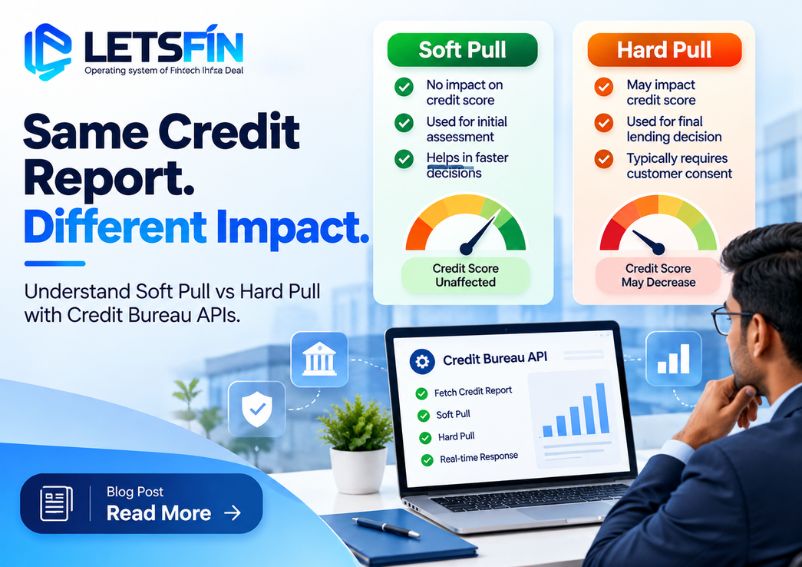
| Soft Pull | Hard Pull | |
| What it does | Checks credit data without leaving a lender-visible inquiry on the applicant's report | Records a formal inquiry tied to a credit application |
| Impact on score | No impact on the applicant's credit score | Can lower the score slightly, especially with multiple pulls in a short window |
| Typical use | Pre-qualification, eligibility checks, offer personalisation before a full application | Final underwriting once the applicant formally applies for credit |
| Applicant experience | Low-friction, often shown as “check your eligibility” | Expected step once someone commits to applying |
The practical rule most lending teams follow: use soft pulls liberally at the top of the funnel to filter and personalise offers without any cost to the applicant, and reserve hard pulls for the point where someone has genuinely decided to apply. Running a hard pull too early is a common, avoidable source of both applicant drop-off and needless score damage.
Bureau Analyser vs. Bureau Soft Pull: Two Different Jobs
These map to two distinct needs in a lending workflow, and it's worth being clear on which one solves which problem before you scope an integration.
| Capability | What It's For | Where It Fits |
| Bureau Soft Pull | A lightweight, score-safe check used to gauge eligibility or pre-qualify an applicant without a formal inquiry | Top-of-funnel: eligibility screens, pre-approved offers, early risk filtering |
| Bureau Analyser | A deeper analysis of the full credit report payment history, active accounts, utilisation, and derived risk signals used to drive underwriting decisions | Underwriting: final credit decisioning once an application is formally submitted |
Many lending stacks need both: a soft pull to keep the top of the funnel frictionless, and a full bureau analysis once an applicant is ready to be underwritten.
The Regulatory Framework You're Working Within
• India's four credit bureaus operate under the Credit Information Companies (Regulation) Act, 2005 (CICRA), which governs how credit data is collected, reported, and shared.
• RBI's Master Direction on Credit Information Reporting requires regulated lenders to both report data to and pull reports from at least one licensed credit information company; it isn't optional infrastructure.
• RBI mandates that borrowers explicitly consent to a bureau pull before it happens, and that consent needs to be captured and timestamped, not assumed.
• Sensitive fields tied to the request, such as PAN, must be handled securely in transit and should not be logged in plain text on application servers.
Where Bureau Data Fits in the Wider Underwriting Stack
A credit bureau API rarely works alone. It's typically one of three complementary data layers modern lenders combine to make a credit decision:
• Bureau data shows how an applicant has handled credit obligations historically
• Bank transaction data shows current cash flow and repayment capacity, which is especially valuable for thin-file or new-to-credit applicants who may not have a deep bureau history
• Identity verification confirms the applicant is who they claim to be before either of the above is even meaningful
For the bank-data layer specifically, LetsFin's Account Aggregator API listing covers consent-based access to real transaction history, and the Bank & Credit Card Statement Analysis API listing covers structured analysis of that data both of which pair naturally with bureau data for a fuller underwriting picture, particularly for applicants with limited bureau history.
Benefits of API-Based Bureau Access
• Instant decisions: real-time pulls replace manual report requests that used to take hours or days
• Score-safe pre-qualification: soft pulls let you filter and personalise offers without hurting applicant scores
• Consistent risk policy: automated retrieval makes it easier to apply the same cut-offs and rules across every application
• Audit-ready compliance: API-based consent and inquiry logging create a clear, timestamped trail for regulatory review
• Multi-bureau flexibility: teams can run waterfalls or parallel pulls across bureaus where a single source doesn't give a complete picture
Common Pitfalls to Avoid
• Running hard pulls too early in the funnel, which damages applicant scores and conversion for no underwriting benefit
• Treating consent as a formality rather than a captured, timestamped, auditable event
• Relying on a single bureau's score as the only input, when coverage and scoring differences between bureaus can meaningfully change the picture for a given applicant
• Logging raw PAN or applicant PII on application servers instead of masking sensitive fields in transit and at rest
• No fallback path for “no-hit” or thin-file applicants, who need alternative data sources rather than an automatic rejection
How to Choose a Credit Bureau API Partner
When comparing providers, look at:
• Which of the four bureaus they connect to, and whether multi-bureau or waterfall configurations are supported
• Whether both soft pull and full bureau analysis are available through the same integration, or only one
• Built-in consent capture and audit logging, so compliance isn't something you build separately
• Response times, since a slow bureau pull is a common bottleneck in an otherwise instant digital lending journey
• How well it complements other underwriting data you're already using, such as Account Aggregator or bank statement analysis
LetsFin's Bureau API marketplace listing lets you compare vetted Bureau Analyser and Bureau Soft Pull partners side by side, so you can match the right capability to the right stage of your lending funnel instead of over-buying or under-provisioning either one.
FAQs
Does a soft pull affect credit score?
No. A soft pull does not create a lender-visible inquiry and has no impact on the applicant's credit score. It's designed specifically for pre-qualification and eligibility checks.
Can a lender use more than one credit bureau?
Yes. Many lenders report to all four bureaus but choose one or two as their primary pull source, and some use multi-bureau or waterfall strategies for specific products or risk segments.
Is borrower consent required before a bureau pull?
Yes. RBI requires explicit borrower consent before a credit bureau pull, and that consent needs to be captured and timestamped as part of the application flow, not assumed from general terms and conditions.
What happens if an applicant has no credit bureau history?
This is typically called a “no-hit” or thin-file case. Rather than an automatic rejection, many lenders route these applicants through alternative data sources, such as bank transaction analysis, to assess creditworthiness.
How is Bureau Soft Pull different from Bureau Analyser?
Bureau Soft Pull is a lightweight, score-safe check typically used for early eligibility screening. Bureau Analyser provides a deeper breakdown of the full credit report used for final underwriting decisions once an applicant formally applies.
In Summary
A credit bureau API is only as good as how deliberately it's used. The teams that get the most out of it treat soft pulls and hard pulls as two different tools for two different jobs, build consent capture in from day one, and pair bureau data with complementary sources like bank transactions for applicants bureau data alone can't fully assess. Compare vetted Bureau API providers on LetsFin to find the right fit for both your pre-qualification and underwriting stages.