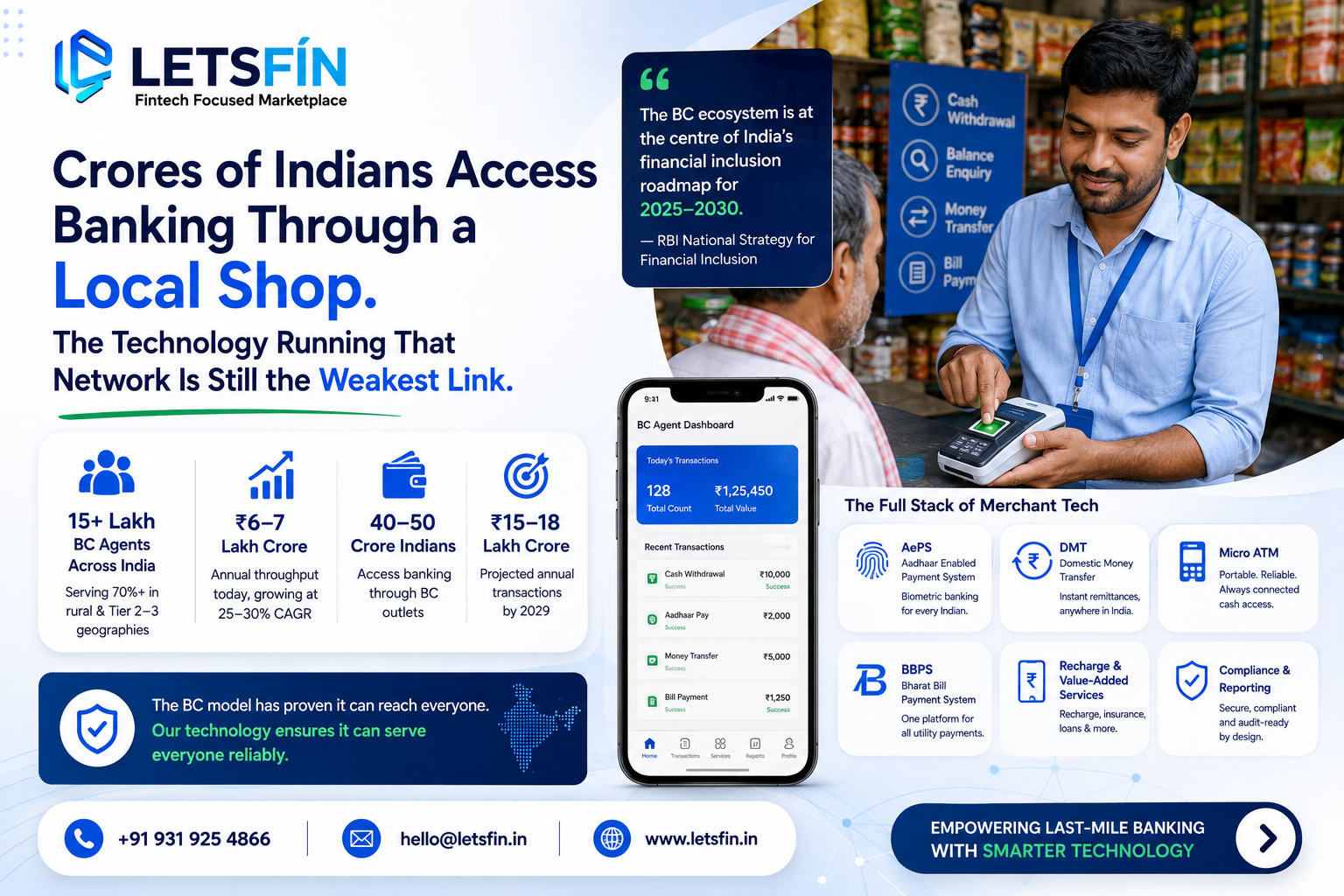
Crores of Indians Access Banking Through a Local Shop. The Technology Running That Network Is Still the Weakest Link.
August 21, 2026
Picture a small grocery shop in a Tier-3 town in Uttar Pradesh. The owner opens at 7 in the morning. By 8 AM, three people are already waiting — not to buy anything, but to withdraw cash, transfer money to a family member in another state, and pay an electricity bill. This shop is not a bank. But for the people standing outside it, it functions exactly like one.
This is the Business Correspondent model in action. It is how over 40 to 50 crore Indians who live beyond the reach of a formal bank branch access their money, transfer it, and increasingly, borrow it. The model works. But the technology that powers most of it — the apps, the APIs, the agent platforms, the settlement infrastructure — is fragmented, unreliable, and significantly behind where it needs to be for the opportunity to be fully realised.
That gap is exactly what Merchant Tech is built to close.
The Scale of What Business Correspondents Actually Do
The BC ecosystem in India is larger than most people outside the financial inclusion sector appreciate. Today, more than 15 lakh Business Correspondent agents operate across the country, with over 70 percent serving Tier-2, Tier-3, and rural geographies. Together, they handle more than half of all basic banking transactions in rural India.
Transaction volumes through this network have been growing at a CAGR of 25 to 30 percent over the last three years, with annual throughput already reaching Rs 6 to 7 lakh crore. By 2029, the BC industry is projected to handle annual transactions worth Rs 15 to 18 lakh crore, expand to nearly 20 to 22 lakh active agents, and emerge as the primary channel for micro-lending, micro-insurance, and digital payments in rural India.
These are not marginal numbers. The BC network is fast becoming the most important financial distribution channel in India — more accessible than bank branches, more trusted than apps for first-time digital users, and more embedded in the daily economic life of the people it serves than any other formal financial touchpoint.
The RBI's National Strategy for Financial Inclusion 2025-2030 has placed the BC ecosystem at the centre of India's financial inclusion roadmap — not as a stopgap until bank branches arrive, but as a permanent, scalable infrastructure layer for the next phase of inclusive banking.
What Merchant Tech Actually Means in This Context
Merchant Tech, in the context of Business Correspondents and last-mile banking, is the full stack of technology that a BC agent or BC network operator needs to deliver financial services reliably, compliantly, and profitably. It is not a single product. It is a layered infrastructure that covers everything from the agent-facing app to the back-end APIs, settlement systems, compliance tools, and lending products that sit on top of the basic transaction layer.
AePS — Aadhaar Enabled Payment System: The backbone of last-mile cash access. AePS allows any Indian with an Aadhaar-linked bank account to withdraw cash, check their balance, deposit funds, or transfer money using just their Aadhaar number and a fingerprint scan — no card, no PIN, no smartphone required. This is the primary service that turns a kirana store or CSC into a functional banking point for India's unbanked population.
DMT — Domestic Money Transfer: The remittance backbone for India's migrant workforce. A construction worker in Mumbai sending money home to Bihar. A factory employee in Surat transferring wages to a parent in a village with no bank branch. DMT enables real-time, low-cost transfers from any agent point to any bank account in the country. For the agents who offer it, DMT is one of the highest-volume, highest-frequency services in their portfolio.
Micro ATM: A portable, biometric-enabled device that allows BC agents to perform card-based and Aadhaar-based transactions without a full ATM installation. Micro ATMs extend cash access to locations where deploying a traditional ATM is not economically viable. They are the hardware layer of last-mile banking, and the technology that powers them — the connectivity, the settlement rails, the uptime guarantees — directly determines whether the agent can serve their customers reliably or not.
BBPS — Bharat Bill Payment System: Utility bill payments — electricity, water, gas, telecom, DTH — through a single integrated platform. For BC agents, BBPS is a high-frequency, low-complexity service that drives daily footfall and builds the customer habit of coming to the agent point for financial needs beyond cash.
Recharge and Value-Added Services: Mobile recharges, DTH top-ups, insurance premium collection, and increasingly, micro-loan facilitation. These services extend the revenue model for BC agents beyond basic transaction fees and create the kind of recurring customer engagement that makes a BC outlet economically sustainable long-term.
Why the Technology Is the Problem, Not the Agents
The BC model has proven it can reach people that banks cannot. What it has not consistently proven is that it can serve those people reliably. And the failure point is almost never the agent. It is the technology stack underneath them.
• Transaction failure rates are too high: AePS transactions fail for reasons that have nothing to do with the customer or the agent — connectivity drops, biometric device timeouts, bank-side processing errors, NPCI latency. Every failed transaction is a customer who does not get paid, a migrant worker whose family does not receive the transfer, and an agent who loses credibility and commission. High failure rates are the single biggest driver of agent churn in the BC ecosystem.
• Settlement delays eat into agent liquidity: A BC agent who processes Rs 50,000 in transactions in a day needs that money settled quickly to maintain the float they need to serve the next day's customers. Delayed settlements — T+1 or longer — create working capital pressure that forces agents to either limit transaction volumes or exit the business. Real-time or same-day settlement infrastructure is not a nice-to-have. It is what keeps agents economically viable.
• Multi-service platforms are fragmented: Most agents today are running separate apps for AePS, DMT, BBPS, and recharges — often from different providers, with different login credentials, different settlement timelines, and different support channels. This fragmentation increases operational complexity, creates reconciliation problems, and significantly raises the training and support burden for BC network operators trying to maintain agent quality at scale.
• Compliance and audit infrastructure is weak: The RBI's BC 2.0 framework has introduced stricter onboarding norms, interoperability requirements, and digital audit trail mandates. Many BC technology platforms are not built to generate the transaction logs, KYC documentation, and audit-ready data that regulated BC network operators now need to satisfy their banking partner requirements.
• No integrated lending layer: The most significant evolution in the BC model is the move from pure transaction facilitation to micro-lending and micro-credit delivery. But for most agents and platforms, the lending product sits completely outside the transaction stack — a separate application, a separate process, a separate provider. The agents who will win the next decade of financial inclusion are those with an integrated stack where the credit product follows naturally from the transaction relationship.
A BC agent who processes 200 transactions a day has more real-time data on their customers' financial behaviour than most NBFCs have on their borrowers. The platforms that connect that transaction data to a credit decisioning engine are building the most defensible position in last-mile financial services.
The Opportunity: From Transaction Agent to Financial Services Hub
The BC model is evolving. The RBI's BC 2.0 framework has not just tightened compliance — it has expanded the scope of what BC agents are permitted to do. Account opening through eKYC, micro-savings products, micro-insurance, pension products, and most significantly, micro-credit facilitation — these are no longer edge cases. They are the next phase of what the BC network is designed to deliver.
The agents and network operators who capture this opportunity are those who have the technology infrastructure to move from single-service transaction points to full financial services hubs. A customer who comes in to withdraw their DBT payment today can be offered a micro-loan tomorrow — if the agent's platform has the credit data, the loan origination flow, and the disbursement infrastructure to make it happen in real time.
How Letsfin Powers the Merchant Tech Stack
Letsfin provides Merchant Tech infrastructure — the full technology layer that BC agents, BC network operators, NBFCs building last-mile lending products, and fintech platforms serving the agent network need to operate at scale.
• AePS, DMT, Micro ATM, BBPS and Recharge APIs: Letsfin's Merchant Tech platform gives agents and network operators a single integrated interface for all core BC services — AePS transactions, domestic money transfer, micro ATM operations, BBPS bill payments, and mobile and DTH recharges. One platform, one login, one settlement cycle, one support channel. The fragmentation that currently costs agents time, money, and transaction volume is eliminated.
• High Success Rate Transaction Infrastructure: Letsfin's transaction infrastructure is built on direct NPCI integrations and multi-bank connectivity, designed to maximise AePS and DMT success rates and minimise timeout and failure events. For agents whose income depends on transaction completion, this is the most commercially significant feature of the platform.
• Real-Time Settlement: Same-day settlement for agents who need liquidity to maintain float and serve high transaction volumes. The working capital pressure that drives agent churn is directly addressed by settlement infrastructure that moves money at the speed of the transaction.
• LOS and LMS with Inbuilt AI for Micro-Lending: For BC network operators and NBFCs building micro-credit products on top of their agent networks, Letsfin's loan origination system handles the full digital lending flow — eKYC, credit bureau pull, account aggregator data, AI-driven credit scoring, and disbursement — in a single integrated journey. The LMS tracks repayment behaviour, generates audit-ready loan data, and uses AI-driven early warning signals to flag at-risk accounts before they become NPAs.
• eNACH and UPI AutoPay for Micro-Loan Repayment: Mandate registration integrated into the loan origination flow, with smart retry logic and pre-debit notifications. For micro-loan products where ticket sizes are small and margins are thin, automated collections infrastructure is the difference between a viable product and one that requires a field collection team that costs more than the interest income.
• Voice AI for Agent Support and Customer Engagement: Automated voice agents in regional languages that handle agent onboarding queries, transaction dispute resolution, loan repayment reminders, and customer outreach. For a network of 15 lakh agents spread across geographies where text-based support channels have low engagement, voice-first infrastructure significantly improves operational efficiency.
• Compliance-Ready Audit Infrastructure: Every transaction logged, timestamped, and audit-trail ready. KYC documentation stored and retrievable. Reporting aligned to BC 2.0 framework requirements. For BC network operators whose banking partner relationships depend on regulatory compliance, this is not optional infrastructure — it is the cost of operating.
Why This Matters Now
The window to build a durable position in last-mile financial services technology is open, but it will not stay open indefinitely. The RBI's BC 2.0 framework is accelerating consolidation — operators who cannot meet the new compliance standards are exiting, and those with the right technology are absorbing their agent networks. The platforms that establish themselves as the infrastructure layer for this consolidation are building network effects that will be very difficult to displace.
By 2029, the BC ecosystem is projected to handle Rs 15 to 18 lakh crore in annual transactions across 20 to 22 lakh active agents. The technology that runs that ecosystem — the settlement rails, the compliance infrastructure, the lending layer, the voice AI engagement tools — will be built in the next two to three years. The operators and lenders building on the right infrastructure now will define what last-mile financial services looks like for the next decade.
The Bottom Line
India's financial inclusion story is not finished. The bank account opened, the QR code deployed, the DBT payment delivered — these are the first chapter. The second chapter is credit, insurance, pensions, and investment products reaching the same people through the same BC agent network, powered by technology that is finally built for the scale and complexity of the job.
Letsfin's Merchant Tech infrastructure is built for that second chapter. If you are a BC network operator, an NBFC building last-mile lending products, a fintech platform serving the agent economy, or a bank looking to extend the reach and capability of your BC network, reach out to the Letsfin team. The infrastructure is ready.