eSign vs eStamp: What Makes a Digital Loan Agreement Enforceable?
October 20, 2026
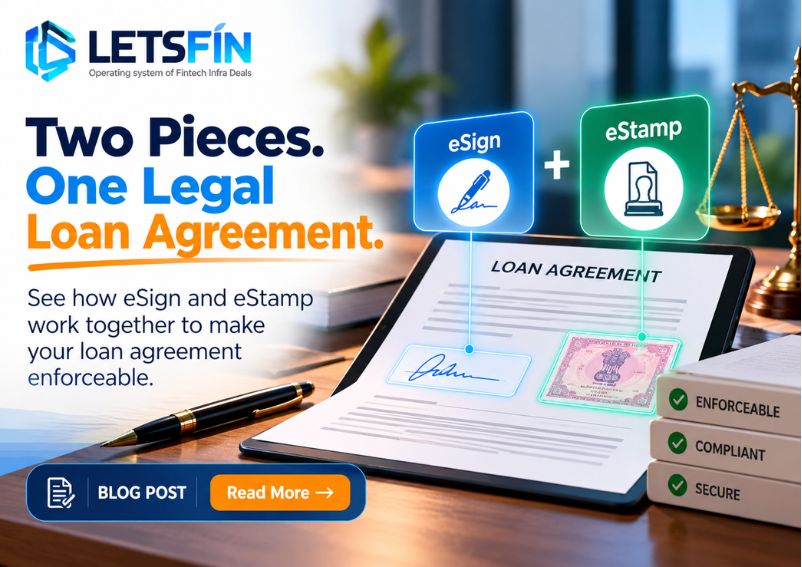
eSign and eStamp solve two different legal problems, and a digital loan agreement in India typically needs both to be fully enforceable. eSign proves who agreed to the document. eStamp proves the government's stamp duty has been paid on it. Skip either one and you're carrying real legal risk into every loan you disburse even if the borrower clicked “I agree” and the loan went through without a hitch.
This is one of the more common gaps in digital lending stacks: teams integrate an eSign API, treat the agreement as “done,” and never separately address stamp duty. This article breaks down what each one actually does, when you legally need both, and how they fit into an underwriting-to-disbursal workflow.
eSign and eStamp Solve Different Problems
| eSign | eStamp | |
| What it proves | That a specific person agreed to and signed the document | That the applicable government stamp duty has been paid on the document |
| Legal basis | Information Technology Act, 2000 Sections 3, 3A, 5, and 10A | Indian Stamp Act, 1899, and applicable state stamp acts |
| Who issues it | Licensed Certifying Authorities and eSign Service Providers, using Aadhaar-based or DSC-based authentication | Stock Holding Corporation of India Limited (SHCIL) and state-authorised collection centres |
| What it replaces | A wet-ink physical signature | Physical stamp paper |
Put simply: eSign is about consent and identity. eStamp is about tax. A document can be perfectly, verifiably signed and still be unenforceable if the required stamp duty was never paid and vice versa, a properly stamped document with no valid signature proves nothing about who agreed to it.
Is eSign Legally Valid for Loan Agreements in India?
Yes. Under Sections 3, 3A, and 5 of the IT Act, 2000, electronic signatures carry the same legal standing as physical signatures for most commercial documents, including loan agreements. RBI's 2022 Digital Lending Guidelines specifically expect digitally signed loan documents as part of a compliant digital lending journey.
There are two broad categories of eSign recognised under the IT Act:
- IT Act eSign types Aadhaar eSign, PAN eSign, DSC tokens, and DocSigner-based signatures. These are required wherever a law specifically mandates a “signature.”
- Other electronic methods clickwrap or “I consent” style acceptance, valid under Section 10A where no specific signature method is legally prescribed.
A small set of documents are excluded from electronic execution altogether under the IT Act's First Schedule, including negotiable instruments (other than cheques) and contracts for the sale or conveyance of immovable property so it's worth confirming your specific document type falls outside these exclusions before assuming eSign alone is sufficient.
Is eStamp Legally Valid for Loan Agreements in India?
Yes. Electronic stamp certificates issued through SHCIL carry the same legal validity as physical stamp paper under the Indian Stamp Act, 1899. eStamping has been available in India since 2013, and SHCIL remains the primary authorised body for issuing and recording e-stamps.
The complication is that stamp duty is a state subject. Several states including Maharashtra, Gujarat, Karnataka, Delhi, Uttar Pradesh, and Rajasthan have specifically amended their stamp acts to recognise electronic records, but requirements, rates, and processes vary by state. A national digital lender needs a stamping process that accounts for this variation rather than assuming one state's rules apply everywhere.
Why Loan Agreements Usually Need Both
Most loan agreements, lease and lending-related deeds, and similar financial documents are stampable instruments under Indian law, separate from whatever signature method is used to execute them. That means the typical sequence for a compliant digital loan agreement looks like this:
- Generate the loan agreement document with the agreed terms
- Apply the eStamp for the applicable state and duty amount
- Route the stamped document for eSign by the borrower (and lender, where required)
- Store the signed, stamped document with a complete, auditable trail
Skipping the stamping step doesn't stop a loan from disbursing the borrower can still eSign and the money can still move but it leaves the agreement more vulnerable to being challenged as improperly executed if it's ever contested or produced as evidence.
Where This Fits in the Lending Workflow
Documentation and execution sit right after underwriting and right before disbursal. If your loan origination system has already pulled bureau data, verified identity, and approved the application, eSign and eStamp are typically the last compliance gate before funds move.
For teams also working through the underwriting side of this flow, LetsFin has covered how LOS and LMS systems can create gaps between approval and disbursal document execution frequently where that gap shows up operationally, even when the underwriting decision itself was sound.
Common Pitfalls to Avoid
- Treating eSign as sufficient on its own and skipping stamp duty entirely for loan agreements that are legally stampable instruments
- Applying a single state's stamping rules nationally, when duty amounts and processes vary by state
- Using a clickwrap-style acceptance where the underlying law actually requires an IT Act eSign type, such as Aadhaar eSign or a DSC
- Not maintaining a complete, timestamped audit trail covering both the signing event and the stamp certificate
- Assuming every document type qualifies for electronic execution, without checking exclusions like immovable property conveyance
Benefits of API-Based eSign and eStamp
- Faster disbursal: agreements that used to take days for physical signing and stamping can be completed in minutes
- Lower operational cost: no printing, courier, or physical stamp paper procurement
- Stronger audit trail: digital timestamps, IP capture, and certificate references replace easily lost paper records
- Consistent compliance: automated, state-aware stamping reduces the risk of applying the wrong duty or process
- Better borrower experience: agreements can be signed remotely, without a branch visit
How to Choose an eSign and eStamp Partner
When evaluating providers for a lending workflow, look at:
- Whether they support the IT Act eSign types you actually need, particularly Aadhaar eSign for consumer lending
- State-wise stamping coverage, since duty rules and rates differ significantly across India
- Whether eSign and eStamp are offered as a single integrated workflow or two separate integrations to manage
- Audit trail depth timestamps, IP logs, and certificate storage that would hold up if a document were ever challenged
- How well it fits into your existing LOS/LMS flow, so documentation doesn't become a manual step between approval and disbursal
LetsFin's eSign API and eStamp API listings let you compare vetted partners for both pieces of this workflow, so you can evaluate state coverage, signature types, and integration depth side by side instead of researching each vendor separately.
FAQs
Do I need both eSign and eStamp for a loan agreement?
In most cases, yes. Loan agreements are typically stampable instruments under the Indian Stamp Act, separate from whatever signature method is used. eSign alone proves who agreed to the document; it doesn't address the stamp duty obligation.
Is Aadhaar eSign legally valid for loan agreements of any value?
Yes. There's no cap on loan ticket size for which Aadhaar eSign can be used, and it carries a high degree of legal enforceability under the IT Act.
Does stamp duty vary by state?
Yes, significantly. Stamp duty is a state subject, and rates, applicable document types, and recognition of electronic records vary across states. A national lender needs a state-aware stamping process rather than a single fixed rule.
Can every type of document be eSigned?
No. The IT Act's First Schedule excludes certain documents, including negotiable instruments other than cheques and contracts for the sale or conveyance of immovable property. Most standard loan agreements fall outside these exclusions, but it's worth confirming for any non-standard document type.
What happens if a loan agreement is signed but never stamped?
The loan can still be disbursed, but the agreement may be considered improperly executed and could face challenges to its enforceability if it's ever produced as evidence in a dispute.
In Summary
eSign and eStamp aren't interchangeable, and treating them as one step instead of two is one of the more common documentation gaps in digital lending. eSign confirms who agreed; eStamp confirms the government's due has been paid and a fully enforceable loan agreement generally needs both. Compare vetted eSign and eStamp API providers on LetsFin to close this gap in your documentation-to-disbursal workflow.