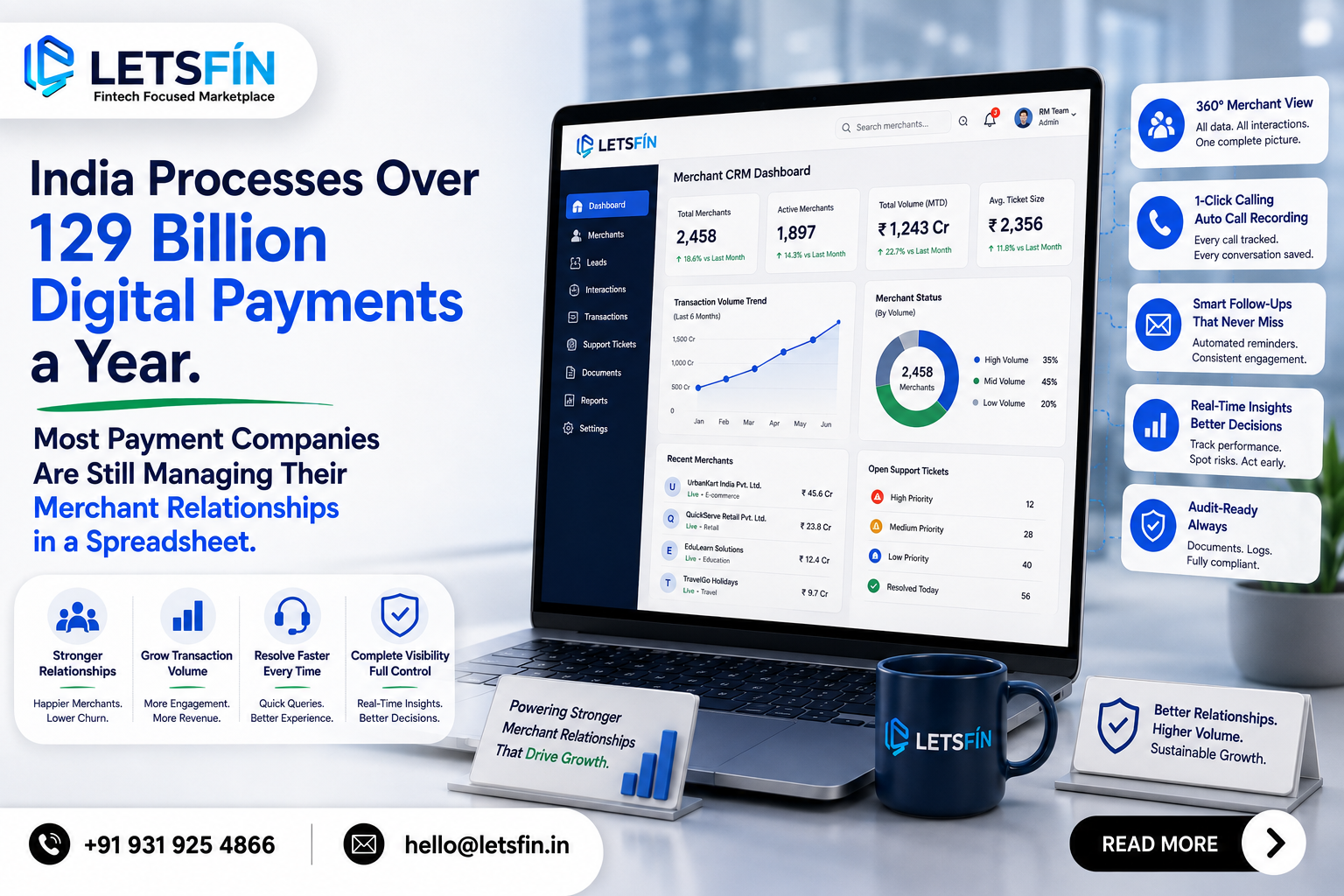
India Processes Over 129 Billion Digital Payments a Year. Most Payment Companies Are Still Managing Their Merchant Relationships in a Spreadsheet.
August 21, 2026
A payment aggregator onboards a mid-sized e-commerce merchant. The sales team closes the deal. The technical team completes the integration. The merchant goes live. Six months later, the merchant's transaction volume has tripled. Nobody at the aggregator has called them. Nobody has offered them a better settlement cycle or an upgraded product tier. The merchant's finance team starts evaluating alternatives. By the time the relationship manager finds out, the migration conversation has already started.
This plays out inside payment companies across India more often than leadership teams want to acknowledge. Not because the teams are not capable — but because the systems they use were built for closing deals, not for managing what happens after the merchant goes live. India's digital payments market is valued at USD 6.83 billion in 2025 and projected to reach USD 33.5 billion by 2034. The infrastructure has scaled remarkably. The merchant relationship management layer underneath it has not.
Why Merchant Relationship Management Is Different From a Sales Pipeline
A payment company's relationship with a merchant does not end at onboarding. It begins there. The merchant expects transactions to succeed, settlements to arrive on time, queries to be resolved quickly, and the payment company to treat them as a partner — not a signed contract. When any of these expectations are not met, the merchant leaves. And in a market where merchant acquisition costs are significant and competition is intense, a churned merchant is an expensive problem.
Generic CRMs track the sale. They do not track what happens after. Payment companies that manage their merchant relationships on a tool designed for sales pipelines end up with the same set of operational failures.
- No unified merchant record: The sales team's notes are in one place, the support team's tickets in another, and the technical team's integration log somewhere else entirely. No single person has the full picture of the merchant relationship.
- Follow-ups depend on individual memory: When a merchant goes quiet, when their transaction volumes drop, or when their query has not been resolved in five days — these signals go unnoticed unless someone is specifically watching for them. Nobody is.
- Merchant communication is inconsistent: Some merchants hear from their relationship manager weekly. Others hear from them when there is a problem. The quality of the relationship depends entirely on individual initiative, not on a system that ensures consistency.
- No visibility into team performance: Which relationship managers are keeping their merchants most engaged? Which merchants are at risk of churning? Without real-time performance data and merchant engagement tracking, these questions go unanswered until it is too late.
- Document and compliance trails are incomplete: KYC documents, merchant agreements, product disclosures — when these are managed across email threads and file folders, they are incomplete by design. Any regulatory review surfaces the gaps immediately.
In the payment industry, the merchant acquisition is not the win. The win is the transaction volume that follows over months and years. A CRM built for payment companies is what protects and grows that volume — not just the tool that tracks the initial sale.
What the Right CRM Delivers for Payment Companies
Here is what a properly configured CRM infrastructure delivers across the payment company merchant lifecycle — based only on verified, confirmed features.
Central Merchant Data Hub — Complete Relationship Picture: Every merchant's business profile, KYC status, product usage, interaction history, payment preferences, and communication log stored in one centralised place. Custom fields capture payment-specific data — transaction volume tier, settlement cycle, product category, integration type, and any other data point relevant to the merchant relationship. Every team member who touches the merchant — sales, support, technical, relationship management — works from the same complete record.
Omnichannel Lead Capture — Zero Leakage: Merchant enquiries from your website, WhatsApp, Google Ads, Facebook, IVR, chatbots, and partner referrals all captured automatically into one pipeline. No manual entry. No duplicate records. Uniqueness rules eliminate lead duplication. Every prospective merchant is accounted for from the moment they first express interest — with no leakage between channels.
Auto-Assignment to the Right Relationship Manager: Merchant leads and enquiries automatically assigned to the right team member based on availability, geography, merchant category, or transaction volume tier. High-value merchant prospects get to senior relationship managers immediately. No delay between merchant interest and first contact.
1-Click Calling and Automatic Call Recording: Every merchant call made with a single click. Every conversation automatically recorded and logged against the merchant record. When a support call comes in about an integration issue or a settlement query, the agent has full context of every prior interaction — without asking the merchant to repeat themselves. Call recordings are accessible anytime for training, quality review, and dispute resolution.
Follow-Up Reminders and Follow-Up Calendar: Automated reminders ensure no merchant follow-up, onboarding check-in, or scheduled review is ever missed. Relationship managers receive WhatsApp notifications when it is time to call. Managers see the full follow-up calendar across the team — with missed follow-ups flagged automatically. For payment companies managing hundreds of active merchants, this is the difference between proactive relationship management and reactive damage control.
WhatsApp, SMS, and Email — From One Platform: Send merchant communications — onboarding updates, integration status, settlement confirmations, product announcements, renewal prompts — directly from the CRM via WhatsApp, SMS, or email. Bulk messaging to segmented merchant groups based on product category, transaction volume, or geography. Automated messages triggered by stage changes or merchant actions. One platform, one communication history, no switching between apps.
Document Management — KYC and Merchant Agreements in One Place: All merchant documents - KYC verification, business registration, agreement copies, product disclosures, compliance records — stored centrally against the merchant record. Accessible to every authorised team member, anytime, from any device including mobile. No requesting the same document twice. No digging through email threads before a compliance review.
Custom Pipelines for Every Merchant Workflow: Create separate pipelines for merchant acquisition, onboarding, technical integration, and account management. Each pipeline configured to match your exact workflow — with stages that reflect the specific milestones in each process. Sales, technical, and relationship management teams each have their own view of the same merchant journey.
Workflow Automation — Consistent Merchant Engagement: Automate the merchant engagement tasks that currently consume your team's time. Welcome messages to newly onboarded merchants. Follow-up sequences for merchants who have not completed integration milestones. Renewal reminders at the right point in a product's lifecycle. Stage-change notifications to the right team member. Every repetitive task executed automatically, consistently, without human intervention.
Payment Reminders and Payment Integration: Send automated payment reminders and payment links directly to merchants from within the CRM. Track payment status against merchant records. For payment companies managing subscription fees, platform charges, or product renewals, this closes the loop between the merchant relationship and the billing relationship — from within the same system.
Real-Time Performance Reports and Dashboards: Track every metric that matters — merchant onboarding rates, activation timelines, engagement frequency by relationship manager, revenue by merchant category, pipeline health, churn indicators. Customisable dashboards accessible from mobile. Revenue forecasts segmented by product, pipeline, and merchant tier. Hour-by-hour activity data for managers who need to identify bottlenecks and redirect their teams in real time.
Role-Based Access Control — Merchant Data Protected: Define exactly which team members can access which merchant data. Sensitive commercial information — transaction volumes, pricing agreements, settlement terms — visible only to authorised users. Field-level controls ensure merchant data stays in the right hands as the team scales across geographies and product lines.
Mobile CRM — Full Access on the Go: The complete merchant relationship — profile, interaction history, documents, follow-up calendar, pipeline status — accessible from a mobile app. For relationship managers and field sales teams who spend time at merchant locations, the ability to log interactions, access records, and manage follow-ups from mobile is not a convenience. It is how the relationship is managed in practice.
Leaderboard and Team Performance Tracking: Track every relationship manager's performance — merchant activations, onboarding completion rates, follow-up adherence, deals closed. A visible leaderboard identifies high performers and flags those who need support before their merchant portfolios show the consequences of low engagement.
Why This Matters Specifically for Payment Companies
- Merchant acquisition is expensive — retention is where the margin is: Acquiring a new merchant costs significantly more than retaining an existing one. Every merchant who churns because of poor relationship management is a loss that compounds — the acquisition cost, the lost transaction volume, and the referrals that merchant would have generated.
- Transaction volume grows with relationship depth: A merchant who trusts their payment partner adds more payment methods, enables more products, and pushes higher volumes through the platform. This growth does not happen automatically. It happens when a relationship manager has full visibility into the merchant's usage and reaches out at the right moment with the right conversation.
- Compliance documentation is non-negotiable: RBI's Payment Aggregator licensing framework requires documented merchant due diligence, KYC records, and interaction trails. When this documentation is managed across spreadsheets and email threads, it is incomplete. A CRM with centralised document storage and interaction logging provides this compliance trail automatically.
- Scale requires systems not headcount: A payment company that wants to grow from 500 active merchants to 2,000 cannot do it by proportionally increasing its relationship management team. Automation, reminders, bulk communication, and pipeline visibility are what make that scale achievable without proportional cost growth.
The payment companies retaining their best merchants and growing transaction volumes from their existing base are not doing it on pricing alone. Pricing gets competed away. Relationship depth, consistent engagement, and proactive account management do not.
How Letsfin Brings This to Your Payment Platform
Letsfin provides CRM infrastructure specifically configured for payment aggregators, payment gateways, PPI wallets, and fintech payment platforms — with the merchant management, calling, document storage, automation, and reporting features that payment relationship management requires.
- One centralised merchant record for every relationship: Business profile, KYC status, interaction history, documents, and communication log — all in one place for every merchant.
- Automatic lead capture from every channel: Website, WhatsApp, Google Ads, referral partners — all feeding into one pipeline with zero manual entry and zero duplication.
- 1-click calling with automatic recording and logging: Every merchant conversation one click away, automatically recorded and attached to the merchant record.
- Bulk WhatsApp to segmented merchant groups: Product announcements, settlement updates, renewal prompts — sent simultaneously to merchants grouped by category, volume tier, or geography.
- Automated follow-up reminders and calendar: No onboarding check-in missed. No renewal conversation forgotten. Every scheduled touchpoint tracked and flagged.
- Document management for KYC and agreements: Every merchant document stored centrally, accessible from mobile, retrievable by any authorised team member instantly.
- Custom pipelines for acquisition, onboarding, and account management: Separate workflows for each stage of the merchant lifecycle, configured to match your exact process.
- Payment reminders and integration: Automated payment reminders and links sent directly from the CRM, with payment status tracked against merchant records.
- Real-time dashboards and performance reports: Merchant activation rates, relationship manager performance, pipeline health, revenue forecasts — visible in real time, actionable without a weekly review meeting.
The Bottom Line
India's digital payments market is growing at 16 percent annually and will not slow down. The merchant base is expanding. Competition for the same merchants is intensifying. The payment companies that build durable competitive positions are not going to do it on transaction pricing or settlement speed alone — those are increasingly table stakes.
The companies that retain their best merchants, grow transaction volumes from their existing base, and expand into higher-value product relationships are the ones with the infrastructure to manage merchant relationships consistently at scale. That infrastructure is a CRM configured for the payment business, and it is what Letsfin provides. Reach out to the Letsfin team to see what that looks like for your platform