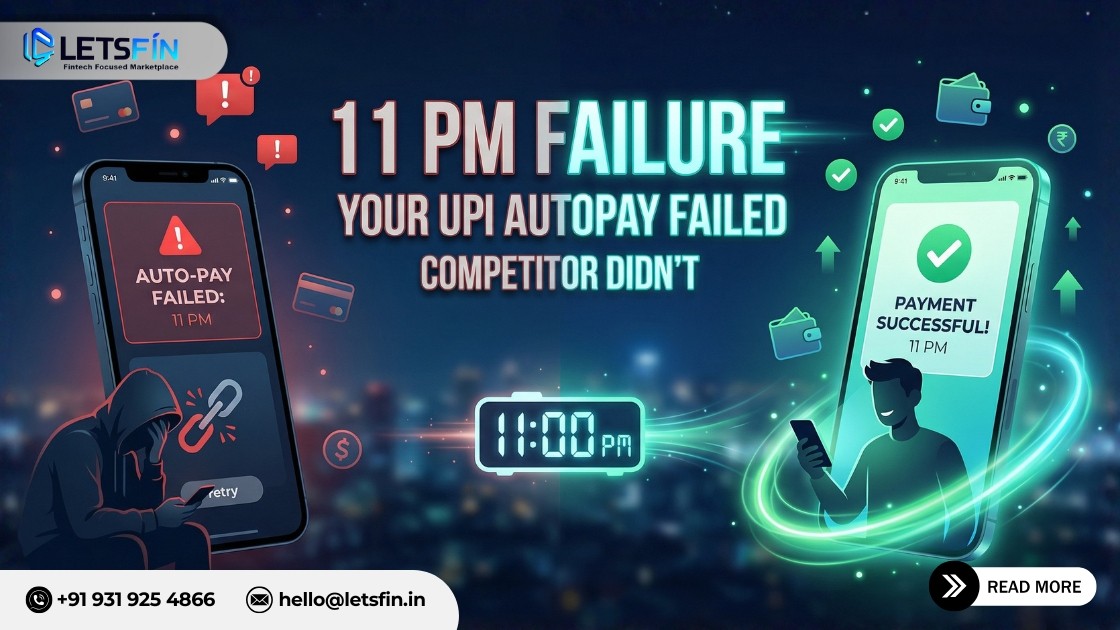
UPI AutoPay Failed Your Borrower at 11 PM. Your Competitor's Did Not.
May 04, 2026
This is a payment tech decision, not bad luck.
There's a number missing from your dashboard: EMIs your UPI AutoPay stack failed last night and never retried. Your collections team doesn’t know this number. Your LMS shows a generic "failed" status. Hidden in those failures is a borrower who had money, an active account, valid mandate – now entering delinquency for reasons unrelated to willingness to pay.
Your competitor collected that EMI. Not because they’re smarter, or because their borrowers are better. They collected it because they made a different infrastructure decision six months ago. The distinction is subtle but critical: payment collection isn’t only about borrower behaviour, it’s about how your infrastructure performs under real-world conditions.
The Problem Nobody Tracks (Because It Happens While Everyone Sleeps)
Collection teams chase delinquency after it happens. By the time teams react, borrowers have already entered 1–30 DPD. What’s rarely measured, however, is how much delinquency was created by the payment stack itself, independent of borrower behaviour.
In simple terms, the question is: how many accounts failed due to infrastructure issues at 11 PM when no engineer was available to monitor the flow? These failures silently accumulate and eventually cost your institution operational resources and borrower trust.
Why This Goes Unmeasured
- Payment failure data sits in one system
- Delinquency data sits in another
- Reconciliation between the two rarely happens
- Most institutions accept failure rates as a baseline
The reality is that baseline isn’t fixed. It’s a deliberate choice. Every unmeasured failure has a cost that is often hidden in reports, and it compounds over time, silently impacting your revenue and borrower relationships.
What Actually Happens to UPI AutoPay at 11 PM
A UPI AutoPay debit is far from a simple transaction. It travels through multiple touchpoints:
- Your payment service provider
- Sponsor bank
- NPCI switch
- Destination bank
The transaction must wait for confirmation before reserving funds. Each step introduces a potential delay, and after business hours, these delays are magnified.
After Business Hours, Every Handoff Changes
- Sponsor bank servers move to slower off-peak queues
- NPCI switch imposes tighter timeout thresholds
- Destination banks run maintenance, creating intermittent unavailability
Generic payment stacks interpret any non-confirmation as a final failure. But this doesn’t mean the borrower’s money isn’t there. It means the technical path between systems narrows between 9 PM and 6 AM. Payment stacks built for this environment know how to navigate these hurdles, while generic stacks do not.
In essence, the difference between a failed and a successful collection often comes down to infrastructure design, not borrower behaviour.
Failure Codes Tell You Everything. Most Stacks Ignore Them
Every failed UPI AutoPay returns a reason code. This isn’t decorative; it’s a precise signal about what went wrong and what action should be taken next.
Critical Categories
- Soft technical declines: Bank timeouts, switch delays, processing queue rejections
- Hard declines: Closed accounts, revoked mandates, regulatory blocks
- Boundary declines: Transaction limits, timing eligibility gaps
- Insufficient funds: Genuine credit signals
Stacks that read these codes and route transactions intelligently recover meaningful percentages of failed EMIs. In contrast, stacks that treat all failures identically simply push everything to collections, creating unnecessary operational costs and borrower friction.
The Mandate Isn’t the Finish Line. Execution Is.
Many lending tech conversations focus exclusively on mandate registration – onboarding UX, activation rates, setup flow optimisation. These elements matter, but mandate registration is only the beginning, not a guarantee of successful debit execution.
What Determines Execution Quality
- Sponsor bank relationships: Multiple banks with dynamic routing based on real-time success rates versus a single fixed path
- Retry architecture: Intelligent retries based on failure type and timing logic versus fixed retries at fixed intervals
- Mandate health monitoring: Proactive tracking of expiry dates, account changes, and deregistration events versus discovering issues only when the next debit fails
- Reconciliation latency: Real-time debit outcome updates versus once-daily batch processing
- Fallback logic: Automatically triggers alternative collection on failed AutoPay versus waiting for human intervention
Each of these layers either adds to or subtracts from your collection rate every night. Ignoring any one layer may silently erode revenue, even if your mandate activation looks perfect on paper.
eNACH vs UPI AutoPay: Different Rails for Different Borrowers
Treating eNACH and UPI AutoPay as equivalent ignores fundamental differences in borrower behaviour and transaction dynamics.
eNACH Works Best For:
- Salaried borrowers with stable, long-tenure bank relationships
- Larger ticket sizes (UPI AutoPay has transaction caps)
- Longer tenure loans, where 2–5 day mandate registration is acceptable
- Predictable end-of-month salary cycles
UPI AutoPay Works Best For:
- Instant mandate activation needs
- Gig economy or self-employed borrowers
- Short tenure or consumer lending products
- Flexible debit scheduling throughout the month
Leading institutions don’t choose one rail over the other. They run both and route borrowers intelligently based on profile and loan type, optimising for both speed and success rate.
The Real Cost of Infrastructure Failure
Payment infrastructure is often evaluated in terms of cost per transaction, per mandate fees, and integration cost. What’s rarely evaluated is the cost of infrastructure-driven failures.
Example: Mid-Size Lender
- 20,000 active borrowers
- ₹9,000 average EMI
- 2% avoidable failure rate
Monthly Impact:
- 400 failed EMIs that shouldn’t have failed
- ₹200 recovery cost per failed EMI (agent time, follow-ups, re-presentation)
- ₹80,000 monthly operational overhead from infrastructure gaps
Additional Costs:
- Provisioning cost for accounts slipping from 0 to 30 DPD
- Borrower trust cost from failed payment notifications
- Co-lending and credit bureau implications
The total cost compounds monthly, silently eroding revenue without appearing clearly in any single report. Over time, it can outstrip obvious operational expenses and technology costs combined.
Questions Your Vendor Should Answer Without Hesitation
- Failure analysis: What is the failure rate segmented by reason code over 90 days? What percentage were soft technical declines recoverable through retry?
- Retry logic: For a debit failing due to bank timeout at 11 PM, how many retries are attempted, at what intervals, and based on what logic?
- Mandate monitoring: How does the system detect underlying bank account changes post-registration?
- Reconciliation: What’s the latency between debit outcome and LMS update?
- Automation: If UPI AutoPay fails three consecutive times, what automated action occurs beyond logging failure?
If your vendor cannot answer these questions with specific, verifiable data, you have an operational gap. That gap costs money, borrower trust, and ultimately, revenue.
Why Letsfin Tech Exists for This Exact Decision
Letsfin Tech is a B2B fintech marketplace connecting banks, NBFCs, fintech lenders, and financial institutions with verified technology providers across core lending infrastructure categories.
Central to the Platform
- eNACH and UPI AutoPay infrastructure
- LOS and LMS systems
- LAMF infrastructure
- Payment orchestration
- Voice Call AI
- Collection technology
The Problem Letsfin Solves
Institutions often realise that their current infrastructure has gaps but don’t have six months to test alternatives. The vendor landscape for payment infrastructure is fragmented, and providers vary significantly in sponsor bank relationships, retry architecture, LMS integration depth, and pricing.
What Letsfin Brings
- Curated, verified eNACH and UPI AutoPay providers evaluated specifically for lending collection use cases
- Ability to compare options across dimensions that drive collection performance: retry logic, reconciliation latency, fallback architecture, and mandate lifecycle management
- Human support from a team with direct experience across investment banking, lending operations, and fintech technology
- No cost to buyer-side institutions – the platform accelerates the right infrastructure decisions without procurement overhead
The EMI Your Competitor Collected Last Night Was Infrastructure, Not Luck
The NBFC that collected at 11 PM didn’t have better borrowers or larger teams. They had payment infrastructure built for after-hours behaviour:
- Reads failure codes intelligently
- Waits appropriately before retrying
- Reroutes through correct sponsor banks
- Confirms collection before anyone woke up
That infrastructure isn’t proprietary. It’s available today. The question is whether you’re measuring payment infrastructure by transaction charges or by the cost of failed collections.
The next step is simple: Evaluate lending-specific payment infrastructure providers who understand these nuances. The evaluation costs nothing, but the next failed debit costs significantly more.
Explore eNACH, UPI AutoPay, and other fintech infrastructure solutions built for India’s lending ecosystem at letsfin.in or write to hello@letsfin.in.
The evaluation costs nothing. The next failed debit does.