What Is Payment Orchestration? When a Single Payment Gateway Stops Being Enough
November 17, 2026
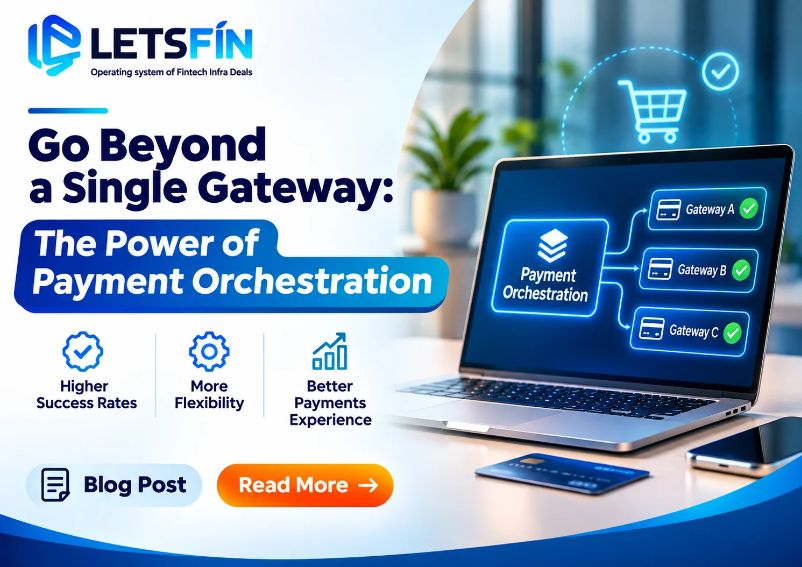
What is payment orchestration? It's a software layer that sits between your business and several payment gateways or aggregators. For every transaction, it decides which provider should handle the payment and what happens if that attempt fails. Your product integrates once with that layer instead of wiring itself separately to each provider.
Picture an EMI collection run at 7 PM on the 5th of the month. Your only gateway starts timing out. Every failed attempt is a borrower who has to retry, and some won't. A second gateway looks like the obvious fix, until you realise you now have two dashboards, two settlement files and a deploy every time you want to change which one gets traffic. That's the point where orchestration enters the conversation.
What Is Payment Orchestration, and What Does the Layer Do?
A payment orchestration layer takes over the decisions your code would otherwise hard-wire to one provider. In practice it handles four jobs:
- Routing: it picks a provider for each transaction using rules such as payment method, amount, cost and recent provider performance.
- Failover: if the chosen provider times out or returns a technical decline, it retries the payment through a backup route.
- Normalisation: it converts each provider's different API formats and status codes into one format your systems understand.
- Unified reporting: it gives finance and operations one view of transactions across providers.
Vendor guides describe the same core pattern: one integration, many providers, with routing, failover, tokenisation and reporting handled centrally. The provider list on the other side is where India differs. It typically includes payment aggregators, bank APIs and UPI rails, not just card processors.
How a Transaction Flows With and Without an Orchestration Layer
Without an orchestration layer (single gateway):
Customer taps "Pay"
↓
Your app → Gateway A (the only connection)
↓
Gateway A → bank / UPI rail
↓
Gateway A slow, down, or declines → payment fails
↓
Customer retries, switches app, or drops off
With an orchestration layer:
Customer taps "Pay"
↓
Your app → Orchestration layer (one integration)
↓
Routing rules check: method, amount, provider health, cost
↓
Gateway A (primary)
├─ success → confirmed, logged, reconciled in one place
└─ timeout / technical decline → check status of attempt 1
↓
Retry via Gateway B (backup)
↓
One unified transaction record
Hypothetical illustration, not a benchmark. Say 10,000 payment attempts hit Gateway A in one evening hour, and 92% succeed. That leaves 800 failures. Suppose 25% of those are provider-side problems that a backup route can recover. That's 200 recovered payments, and the success rate moves from 92% to 94%. At an assumed average ticket of ₹2,000, that's ₹4,00,000 in payments that would otherwise have failed. These numbers are invented to show the arithmetic. Your real recovery rate depends on why your payments fail.
The 25% assumption matters. A declined payment because of a wrong PIN or low balance won't succeed on a second gateway. Orchestration recovers a slice of failures, not all of them.
Payment Orchestration vs Payment Gateway: What's the Difference?
A gateway is one connection to one processor, while orchestration manages multiple gateways at once. Here's how that plays out:
| Single payment gateway | Payment orchestration layer | |
| Connects to | One provider | Many providers, banks and rails |
| Routing | Fixed path | Rule-based or dynamic, per transaction |
| Failover | Built by you, if at all | Automatic retry via backup route |
| Reporting | One provider's dashboard | Unified view across providers |
| Best fit | Early stage, one main method, steady volume | Several methods or providers, volume where failures cost real money |
| Main drawback | One point of dependency | An extra layer to run, pay for and trust |
Many Indian businesses reach gateways through payment aggregators. Under the RBI's Master Direction on Regulation of Payment Aggregators (September 2025), non-bank aggregators need RBI authorisation, and the funds they collect sit in escrow accounts with scheduled commercial banks. In the usual setup, the orchestration layer routes requests while the regulated aggregator or bank still collects and settles. Confirm that division of roles with any vendor you evaluate.
If you're still at the stage of picking your first provider, our earlier piece on choosing a payment aggregator for speed alone covers what to weigh before orchestration becomes relevant.
How Smart Routing Works for Payments in India
Multi-gateway routing starts with rules. A basic setup might send UPI to Gateway A and cards to Gateway B. A more mature one adds signals such as:
- payment method (UPI, cards, netbanking, wallets)
- ticket size
- time of day, since provider performance can dip at peak hours
- each provider's recent success rate and response time
- the cost of each route
- the business line, for example EMI collection versus merchant checkout
Static rules are easy to reason about. Dynamic routing shifts traffic as provider performance changes, which is the stronger form of smart routing for payments in India. It also needs clean data on why each payment failed, which is where most teams discover their logging has gaps.
Payment Gateway Failover: What to Retry and What to Leave Alone
Payment gateway failover sounds simple, and the details are where it goes wrong.
Usually safe to retry on another route:
- provider timeouts and server errors
- technical declines on the provider's side
- a provider that's visibly down
Don't retry on another gateway:
- wrong PIN or OTP
- insufficient balance
- customer cancellation
- anything your fraud checks flagged
One more rule matters more than the others. A timeout doesn't prove the payment failed. Retrying without confirming the first attempt's status can produce two successful charges. Check status first, then retry, and log every failover event with a transaction ID so reconciliation can trace it.
Signs You've Outgrown a Single Payment Gateway
Tick what applies:
- Your failure graph shows clear dips around provider slowdowns, and ops hears about them from customers first.
- Success rates differ noticeably by payment method or issuing bank, and you have no way to act on it.
- You added a second gateway, but switching traffic between them needs a code change.
- Finance reconciles from several settlement files in spreadsheets.
- You can't push back on pricing because you have no credible alternative route.
- Each new payment method means another integration project.
- Peak days (sale events, salary dates, EMI dates) bring visible failure spikes.
- Support keeps hearing "money debited, order failed."
This is an editorial rule of thumb, not an industry standard: if three or more apply, it's worth evaluating orchestration. One or two usually point to a fixable gateway configuration or a conversation with your provider.
What Orchestration Costs You
It isn't free of trade-offs, and any vendor who skips this section is selling.
- A new dependency. The layer itself can become a single point of failure if it goes down, so ask about its uptime and incident communication.
- Migration effort. Mapping integrations, configuring routing rules and testing failover can take weeks for complex payment stacks.
- Rules need upkeep. Routing logic that nobody reviews drifts out of date as provider performance changes.
- Compliance sits with you. Every connected provider still needs to be properly authorised and contracted. For regulated entities, check what your compliance team requires on data handling and localisation before routing traffic across providers.
And sometimes the right answer is to stay put. With one dominant payment method, steady volume and a gateway that performs well, an extra layer is overhead.
Questions to Ask Before You Choose an Orchestration Platform
1. Which gateways, aggregators and bank APIs are already integrated, and which would be new work?
2. Who controls the routing rules, and can you change them without a release?
3. How does the platform decide whether a failed attempt is safe to retry?
4. How are settlements and reconciliation presented across providers?
5. Where is payment data stored, and what does your compliance team need to see?
6. What happens to your payments if the layer itself has an outage?
Where LetsFin Fits
LetsFin is a fintech software marketplace where businesses compare technology providers. Its payment orchestration and gateway core category lists both a Payment Gateway and a Payment Orchestration solution. The orchestration listing describes a five-step flow: it accepts channels such as UPI, AEPS, IMPS, branch, POS and QR; its routing engine chooses a cost-beneficial provider; it executes through NPCI, CBS or bank APIs; it logs, secures and reconciles in real time; and it delivers the experience through an app, agent or account officer.
That's the listing's own description. Supported providers, routing controls and integration timelines are questions for a demo, and the list above is a good agenda for it.
Next step: if you're weighing this decision, open the payment orchestration and gateway core page and use Compare to line up the options. Or use Talk to Tech Specialist on LetsFin to talk through your payment flow with someone who can help you shortlist.
Frequently Asked Questions
Is payment orchestration the same as a payment aggregator?
No. An aggregator collects payments on behalf of merchants and is a regulated entity in India. An orchestration layer decides which provider to send each payment to. A business can use orchestration to route across several aggregators.
Does orchestration guarantee a higher success rate?
No. It can recover failures caused by provider outages or technical declines, and it can send traffic to better-performing routes. It can't fix customer-side declines, and the gain varies by business.
Can we build this in-house?
Yes, and some teams do. The ongoing cost is maintaining provider connections, routing logic, retry rules and cross-provider reconciliation. Without a layer, a business either accepts one provider's performance or maintains separate integrations to several, so build-versus-buy depends on how many providers you'll connect.